


The national average cost of a memory care facility is about $6,999 per month, according to proprietary data from A Place For Mom. Costs vary by state, location, and care needs, but that monthly rate often includes housing, meals, 24-hour supervision, safety features, and specialized dementia care. Some communities charge one all-inclusive fee, while others adjust pricing as care needs change. Understanding these costs can help families plan with greater confidence during a challenging transition.
Key Takeaways
- The national average cost of memory care is about $6,999 per month nationally, but prices vary significantly by state, community, and care needs.
- Memory care typically includes housing, meals, 24-hour supervision, medication management, safety features, and specialized dementia care in the monthly rate.
- How a community prices memory care matters because some charge one all-inclusive monthly fee while others increase costs as care needs change.
- Reduce out-of-pocket costs by comparing pricing models, asking about incentives, and exploring Medicaid, veterans' benefits, or advisor guidance.
Monthly memory care costs by state
Depending on the state, the average cost of memory care ranges from about $5,250 to $11,314 per month, according to A Place for Mom’s proprietary data.
Location and cost of living are two of the biggest factors affecting memory care costs. For example, a community located in a large metropolitan area, near a desirable destination, or in an area with a higher cost of living is often more expensive.
The table below provides the average monthly cost of memory care in each state.

A Place for Mom
The most and least expensive states for memory care
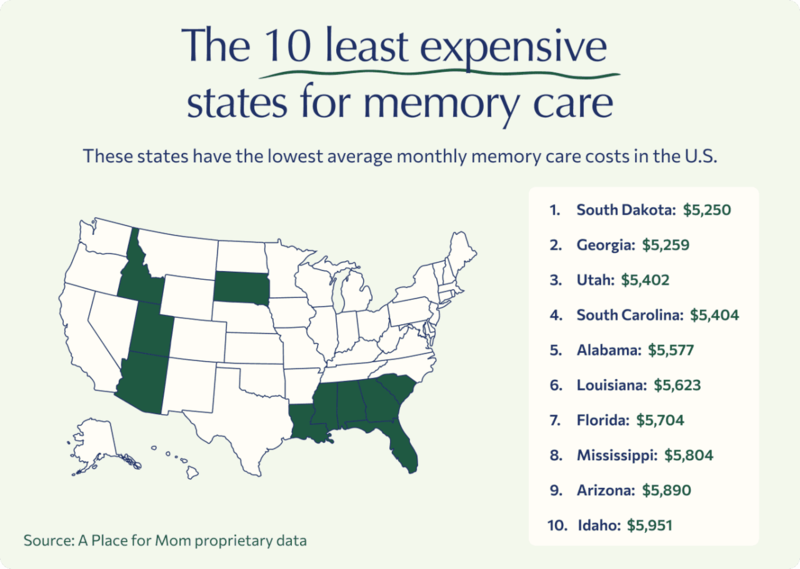
Memory care costs vary significantly across the U.S. due to factors such as availability and differences in the cost of living. The most expensive state for memory care is Vermont, while the least expensive state is South Dakota.
See the 10 most expensive and 10 least expensive states for memory care below.

A Place for Mom
A Place for Mom
What’s included in the price of memory care?
While features and amenities vary, the base rate for memory care typically includes:
- Housing
- Three nutritious meals a day, plus snacks
- 24-hour care and supervision with a low resident-to-caregiver ratio
- Safety protocols, including gated entrances, video surveillance, and systems to monitor residents for wandering
- Emergency response systems (for medical emergencies)
- Housekeeping and landscaping services (to reduce resident stress and responsibility)
- Assistance with bathing, dressing, and other activities of daily living
- Medication management
- Transportation to medical appointments
- Memory-enhancing therapies and social activities
Are memory care fees all-inclusive?
Most communities that provide only memory care charge an all-inclusive fee. Residents and their families pay one monthly fee for all available services and amenities. Because dementia can be unpredictable, these communities typically allow residents to receive more specialized services as care needs increase without charging more in monthly fees. However, in some communities, a few advanced care services or amenities may cost extra.
How does the cost of memory care compare to costs for other types of senior living?
According to A Place for Mom's proprietary data, the national average cost of memory care is about 20% more than assisted living and about twice the average cost of independent living. Compare the average cost of memory care with other types of care below.

A Place for Mom
Memory care offered within assisted living communities
Some assisted living communities include dedicated memory care units, which can affect how memory care is priced. These communities often allow residents to age in place, with costs increasing as care needs grow. Within A Place for Mom's nationwide network, about 14% of communities provide memory care only. Many partner communities offer memory care alongside assisted living and independent living on the same campus.
When memory care is provided within communities that offer multiple types of care, it's common for residents to be charged more as they age and their care needs increase.
In such arrangements, the community will charge a base rate for standard amenities and services. Residents will then undergo a care assessment upon admission to determine what other services are needed. The community will perform additional assessments at regular intervals to identify changing needs and ensure the resident’s care plan meets those needs. The total monthly cost equals the base rate plus any add-on services identified during the assessment. For example, common add-on services include:
- Diabetic injections
- Incontinence care
- On-site salon services (haircuts, manicures, and other spa treatments)
- Pet fees
- Internet or cable service
- Special outings
Tips to save on memory care costs
Touring multiple communities, asking the right questions, and ensuring your loved one lives in the most appropriate area of a community that offers multiple kinds of care can help reduce costs. That is, paying one fee to live in the memory care unit of a community may be more cost-effective than paying for the same services as add-ons in the assisted living area.
Mark Young moved his mom from assisted living into memory care within the same community. He says the transition ended up saving them money. His mom was receiving level 5 care (the highest level) in the assisted living area, resulting in a higher cost. However, in the memory care part of the community, his mom’s care needs were only considered a level 3 (an intermediate level). This move helped Young’s family save almost $1,000 per month while ensuring his mom receives the specialized care she needs.
Public programs, such as veterans benefits and Medicaid, can also help lower the out-of-pocket cost of memory care. During his search for his mom's care, Young learned that many residents use savings and pensions from their working days to fund memory care. Because those funds may be limited for some, he recommends that anyone searching for memory care ask whether communities accept Medicaid. He cautions that you never know when your loved one may exhaust private funds and need it.
Expert Tips: How To Save On Memory Care Costs
- Consider a roommate. For seniors who prefer companionship, splitting the cost of a room with another memory care resident can almost cut the price in half.
- Move at the right time. Communities often set move-in goals, so check in at the end of a month, quarter, or year for lower prices.
- Ask for a deal or move-in incentive. Prices can be looked at as a starting point for negotiation. Some communities will let you know of upcoming incentives or offer veteran discounts. They may even work with families who are just shy of affording the asking price.
Why is memory care more expensive than other types of care?
Several factors make memory care more expensive than independent living or assisted living.
Specially trained staff
Dementia care requires specific skills and ongoing memory caregiver training, says Niki Gewirtz, a training manager at A Place for Mom. Gewirtz has been helping families find the right long-term care setting for more than 20 years.
"Staff in memory care communities know how to meet residents where they are and provide exactly what they need. From helping a resident take a shower to helping them feel successful in whatever they do, memory care staff use a person-centered approach to care," says Gewirtz.
Memory caregivers are also trained in redirection techniques and specific communication methods to help manage common dementia behaviors, such as confusion, anxiety, and aggression.
Low resident-to-staff ratios
Memory care communities have lower resident-to-staff ratios, says Gewirtz, because people who have dementia often require more attention and support — and more frequently than residents in other settings.
“Staff in memory care communities must pay close attention and become very familiar with what each resident needs. That costs more,” explains Gewirtz.
As dementia progresses, people tend to need more help with feeding themselves, and incontinence is more common.
“More staff are needed in dining rooms and housekeeping,” Gewirtz says.
Enhanced memory care facility design
Memory care facilities or communities offer a safe and secure environment to help prevent wandering while providing a secure environment. Advanced security systems, locks, unique building layouts, and special design features that reduce confusion and support wayfinding cost more to build.
Person-centered care and programming
Memory care activity programs include unique social events and therapies that are highly personalized to accommodate the unique needs of seniors who have dementia. Activity schedules are usually designed to help residents eat, sleep, and exercise better, and they accommodate residents' capabilities, according to Maureen Bradley, a former executive director of a memory care community, who now works at A Place for Mom.
12 questions to ask about memory care costs
Families can ask the following questions so they can clearly understand what memory care costs are in their area and avoid surprises later on:
1. What's the base monthly price? While the base rate mentioned above will likely apply, specific care charges can change month to month depending on factors like time of year, vacancy, and staff availability.
2. What's included? What's not? Many communities charge an all-inclusive monthly fee, but some communities set different prices based on care needs. Be sure to clarify the care and services included in the price.
3. How much do the various floor plans cost? Most memory care communities have studio or shared room options. Some may offer one- and two-bedroom units for a higher price.
4. Does the price increase annually? Memory care prices typically increase 3% to 8% each year. Ask prospective communities about previous rate increases and their policies for communicating these changes to residents.
5. Is there a community fee or deposit? Many communities charge a one-time community fee. The national average memory care community fee is $3,000, according to A Place for Mom's proprietary data. This fee covers the extra services and one-on-one time needed to help a new resident adjust to the community.
6. Are there any move-in incentives? Many communities offer discounts, such as:
- End-of-year rates. Deals are common around the holidays, when fewer people want to move.
- Rate lock-ins. Some communities may offer to freeze their rate — called a rate lock — for two years or more.
- Waived community entry fee. This initial payment may be eliminated as an incentive.
7. What's the maximum amount of care offered? Your loved one's care needs will be evaluated as part of the move-in process. However, care needs may change over time. Knowing the maximum price and care options available can help your family plan accordingly.
8. How often are care plans reviewed? If your loved one goes to the hospital, or if their health changes, they may need different services and treatments. A plan outlining required care is important to your loved one's health, and it can affect the total cost.
9. What happens if our family can no longer pay? Is there a grace period if unforeseen financial difficulties arise? Does the community provide any resources? "In most cases, the family and community will monitor financial resources together," says Lynn Moore, a senior living advisor at A Place For Mom. "If the family is spending down during the look-back period, additional options may be presented. When funds are exhausted, the loved one may need to be relocated to a community that accepts public assistance, like Medicaid."
10. Are there activities and amenities included in the cost? Some communities may offer additional specialized activities in addition to those regularly scheduled on their events calendar. Your family may have to pay extra for services such as golf outings, aqua therapy, or more extensive crafts.
11. If your loved one chooses a nonprofit community, is there a foundation that can help if their funds run out? Sometimes, nonprofit communities partner with organizations or foundations that can help long-term residents cover their care costs. Check with a prospective community to see what options may be available.
12. Will we need to purchase any specialty items? Ask if there are any items related to your loved one's care that you'll need to pay extra for.
“Many communities still require you to pay for personal items like incontinence supplies and personal hygiene items,” Moore notes.
FAQs
Can I negotiate the cost of memory care?
Yes, you may be able to negotiate memory care costs in certain circumstances. Some communities will lower the price if the cost is just shy of your budget.
How can I be sure my loved one and I understand the total cost of memory care?
Ask for a breakdown of the community’s base cost versus fees for additional services and amenities. For example, some memory care facilities may charge an additional fee for community maintenance.
Can my siblings or I be held responsible for paying our parents’ memory care costs?
No, you typically can’t be held responsible for paying for a parent’s memory care costs. However, if you signed their lease as a guarantor or if you misappropriated their funds, you may be responsible, according to The Chamberlain Law Firm. If you have any concerns, it’s best to talk to an attorney.
This story was produced by A Place for Mom and reviewed and distributed by Stacker.