


A Place for Mom surveyed more than 1,000 adults ages 40 to 80 in June 2026 to understand how they picture later life, what they expect may change, and how much they've done to prepare. While most respondents wanted to remain in control of their lives as they age, this research reveals a consequential gap between that aspiration and the preparation required to achieve it. For example, only 11% had made specific or complete plans for a time when they might need consistent help with daily life. Even among older respondents aged 60 to 80, just 12% had a plan.
People are aware of what aging may bring, but their expectations often depend on arrangements that haven’t been fully discussed, tested, or funded. More than half of respondents expect family members, friends, or others to provide most or all of the help they may need. Almost 60% view their current home as definitely or possibly their “forever home,” yet only 18% said they’d discussed potential modifications that would enable them to age in place. At the same time, 4 in 10 respondents were unsure whether they could afford professional care for as long as they need it.
These findings point to a broader challenge: awareness alone isn’t moving people to action. Planning isn’t a concession that independence is ending; it’s one way people can protect it. Earlier, more concrete conversations about housing, mobility, finances, family roles, and professional care can help people retain greater agency and give families more realistic options before needs become urgent.
What matters most in later life
Respondents were split pretty evenly across their top priorities for aging, indicating that there are many critical elements to aging successfully. They most often included being financially comfortable (32%) and maintaining independence (31%) among their top three priorities for later life. Staying physically healthy (28%) and mentally sharp (27%) were close behind.
Older adults were more likely to rank maintaining independence among their top priorities: 24% of those in their 40s selected it, compared with more than 35% of those in their 60s through 80s.
Feeling confident about those priorities was another matter. Those who prioritized having people they could count on felt most confident they could achieve it, and confidence was also relatively high among those who prioritized staying in their current home. Those who prioritized financial comfort, not becoming a burden on others, physical or mental health, or independence felt less certain.

A Place for Mom
For many respondents, remaining independent still includes getting some help. About 40% said they expect to need some support while still living mostly independently. Among those in their 60s, 70s, and 80s, that rate rose to nearly 50%. However, overall, one-third said their plans mostly assumed they would remain healthy and independent and would need little or no additional help.
The need for help still feels years away
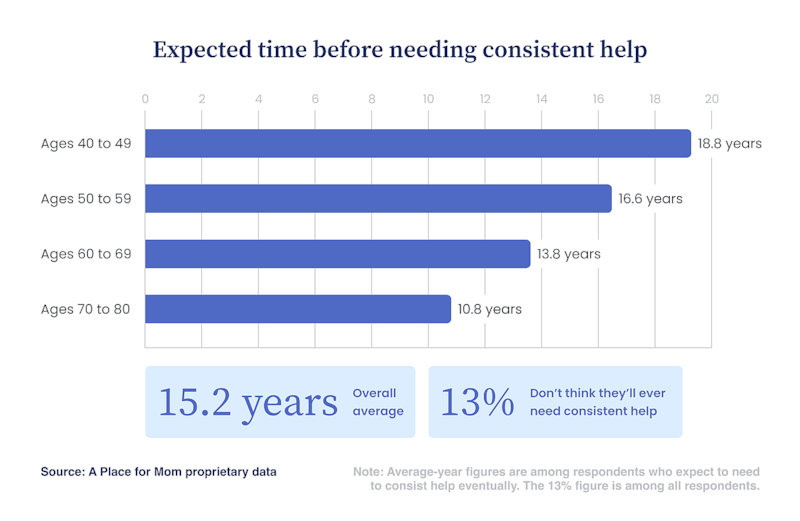
Respondents in every age group expect to have substantial time before they need consistent help:
- Ages 40 to 49: 18.8 years
- Ages 50 to 59: 16.6 years
- Ages 60 to 69: 13.8 years
- Ages 70 to 80: 10.8 years
In fact, 13% said they didn't think they would ever need consistent help.
A Place for Mom
Among those who said they’d considered that they’d eventually need help, 67% had thought about their financial preparedness, 63% about the care or support they might need, 61% about where they would live, 52% about legal plans, and 48% about what would happen if they could no longer drive.
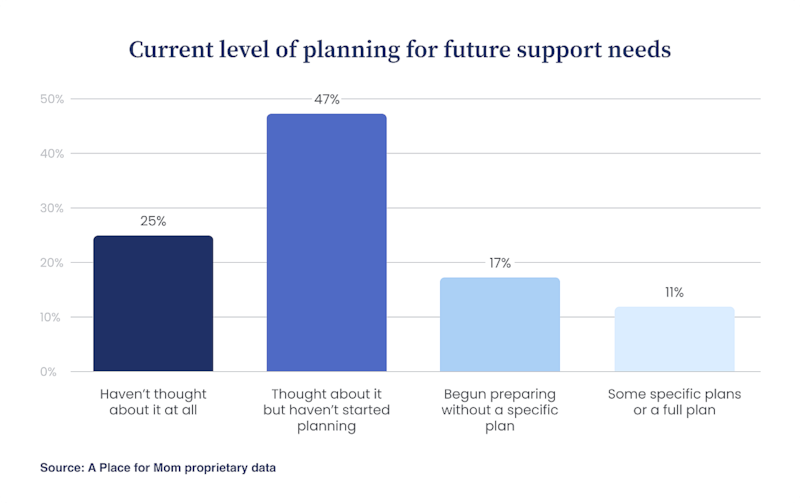
Still, relatively few people had turned their thinking into specific plans. Only 11% had some specific plans or a full plan. Another 47% had thought about it but had not started planning, while 17% had begun preparing without putting a specific plan in place. Twenty-five percent had not thought about this stage of life at all.
A Place for Mom
Many people expect family to support them as they age
More than half of respondents said they expect family members, friends, or others to provide all or most of the support they’d need. About 40% said they expect their spouse or partner to help them, and another 40% expect help to come from their children or grandchildren. Twenty-nine percent expect support from other family members. By comparison, just 17% expect to get help from a professional caregiver.
Expectations differed considerably by gender. Women were much more likely than men to expect help from children or grandchildren, 51% compared with 29%. Men were somewhat more likely to expect help from a spouse or partner, 45% compared with 38% of women.
While many respondents expect to need help as they age, one-third also said accepting help from others would be somewhat or very difficult. Across the survey, respondents often appeared more comfortable acknowledging a future need in the abstract than confronting what that need could mean for them personally.
Even among respondents who expect support from a spouse, partner, children, or grandchildren, relatively few have turned those conversations into specific plans.

A Place for Mom
Respondents were also thinking about the effect their needs could have on those relationships. Nearly one-quarter of respondents said not being a burden on family or friends was important to them. A similar share said knowing they have people they can count on is a top priority.
Most people think their homes will work for them as they age
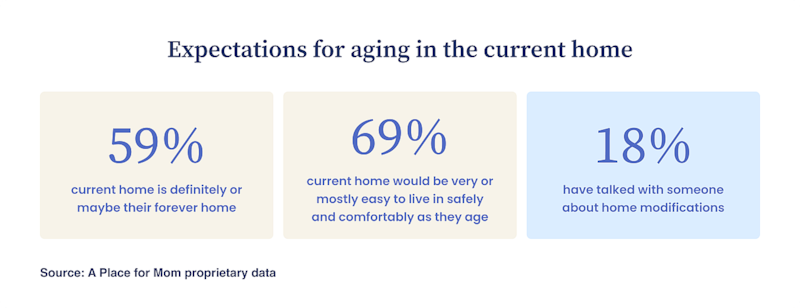
Overall, nearly 60% of respondents said their current home is definitely or maybe their forever home. That expectation was more common among older respondents: 44% of those in their 40s said their current home is definitely or maybe their forever home, compared with 63% of those in their 60s and 76% of those ages 70 to 80.
Most also believe their homes could reasonably accommodate them as they age. Sixty-nine percent said their current home would be very or mostly easy for someone to live in safely and comfortably as they get older and experience health-related challenges.
Among respondents who thought their homes might need at least some adjustments, 48% said they might add bathroom safety features such as grab bars or a walk-in shower. Twenty-seven percent said they might add handrails or other supports, while 25% said they might improve access between floors or thresholds with features such as ramps, stairlifts, or elevators. Some respondents had also considered simpler layouts, emergency-alert technology, removal of tripping hazards, main-floor bedrooms and bathrooms, and wider doorways or walkways.
Although respondents said that bathroom safety updates and changes to enable access to multiple floors were important, 18% said bathroom safety updates might be too expensive, and 16% anticipated cost would prevent them from improving access between floors or across thresholds. Still, 38% said none of the listed modifications would be too expensive.
A Place for Mom
Those who thought their homes would require adjustments estimated that those modifications would cost about $16,380. Their estimates span a wide range: 12% expect costs below $2,000, 29% expect $2,000 to $9,999, another 29% expect $10,000 to $29,999, and 13% expect to spend at least $30,000. Seventeen percent said they had no idea what the changes would cost.
Respondents had a reasonably grounded sense of what the work could cost, although expenses vary widely depending on the changes they choose and the home itself. Recent cost guides put common projects in the following price ranges.
- Grab bar installation: about $100 to $450
- Straight stairlift: about $2,500 to $5,000
- Walk-in shower: roughly $6,000 to $10,000
- Accessible bathroom renovation: about $8,000 to $25,000
- More extensive structural modifications: $10,000 to $50,000 or more
Although respondents’ average estimate for home modifications fell within a plausible range, few said they’d already explored the possibility. Only 18% said they’d talked with someone about home updates, and among respondents ages 70 to 80, only 12% had done so. Again, this underscores the gap between an ideal future state and taking the steps needed to get there.
How caregiving experience influences thinking about aging
More than half of those surveyed had been caregivers themselves: 15% were currently helping support or care for someone age 65 or older, while 39% had done so in the past. Another 16% had watched a family member or close friend provide care.
Those with direct caregiving experience were more likely to say it influenced how they think about their own aging. Among respondents who were current or former caregivers, 78% said the experience strongly or somewhat influenced their thinking. In contrast, 61% of respondents who had only seen someone else be a caregiver said that experience influenced how they thought about aging.
The difference between doing the work and observing it is one of the more revealing findings in the survey. Those who had personally arranged rides, managed appointments, researched care, helped with daily needs, or made decisions for an older adult were more likely to say that experience affected how they think about their own future.
How affordability affects future care choices
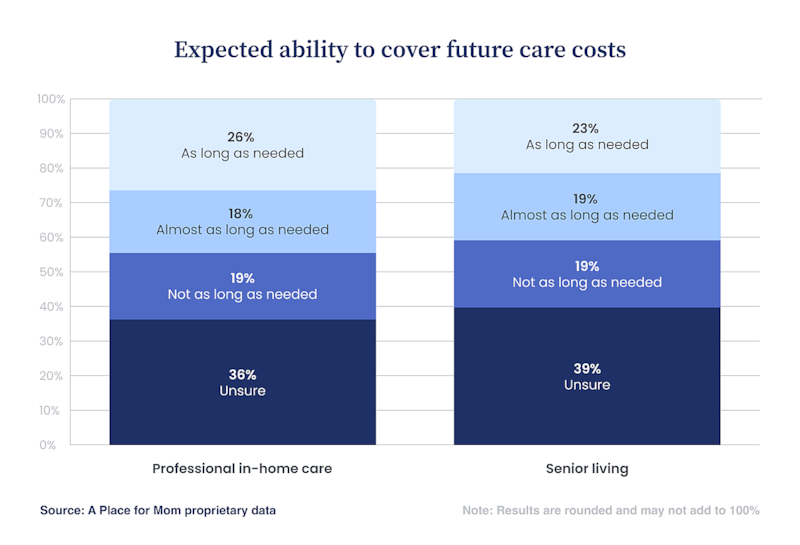
When asked to think about paying for professional support later in life, most respondents (about 75%) were unsure whether they could cover the cost of either in-home or residential care for as long as they may need it.
A Place for Mom
Cost was also the leading concern among respondents who were hesitant about professional care. Among respondents who wouldn’t consider in-home care or were unsure about it, 61% cited high cost as a reason. Among those who wouldn’t consider senior living or were unsure, 68% cited cost.
A Place for Mom’s pricing data gives a sense of what those costs may be. Assisted living averages $5,830 per month, or $69,960 per year, while memory care averages $6,999 per month, or $83,988 annually. Independent living averages $3,520 per month, or $42,240 per year. Professional home care starts at about $32 an hour.
Four in 10 women were uncertain about how long they could afford either in-home care or senior living, compared with about one-third of men. Women were also more likely to say they had considered the challenge of affording future care or support: 48% compared with 39% of men.
Respondents reported considering a wide range of possible living and care arrangements for later life. Two-thirds said they would consider independent living, described as a residential community offering a maintenance-free lifestyle, amenities, dining options, and activities for self-sufficient adults. Fifty-five percent would consider a 55+ community, described as a neighborhood for older adults. And about half said they'd consider living with family, assisted living, or professional in-home care, while 39% would consider memory care and 21% a nursing home.
Whether those options remain realistic may depend in part on what respondents can afford. With cost already a leading concern and many unsure how long they could afford professional support, affordability could ultimately preserve or limit their choices about where and how they receive care.
What these findings reveal about planning for independence
Survey respondents were aware of the changes that aging may bring. They had considered finances, care, housing, transportation, family support, and possible changes to their homes. Despite this, only a small share had made specific plans for a time when they might need consistent help.
People who want to remain in control of their lives as they age may need to do more than understand what could change. Making decisions about housing, mobility, finances, support, and care before those choices become urgent is critical.
One implication for the broader aging and care system is that information alone isn’t enough to move people from awareness to action. Many people already understand what aging independently may require, but far fewer have translated that understanding into specific plans.
Methodology
This report draws on a June 2026 online quantitative survey commissioned by A Place for Mom and conducted by Morning Light Strategy.
The survey included 1,004 U.S. adults ages 40 to 80. Respondents who were currently living in senior living, receiving professional in-home care or support, or actively searching for care were excluded. Quotas were balanced to U.S. Census benchmarks for age, gender, region, ethnicity, and income. The survey examines expectations and preparedness among adults who had not yet entered the professional senior care system at the time of the research.
FAQs
Does planning for later-life support mean giving up independence?
No. Planning can help people protect their independence by identifying preferences, support options, and financial considerations before a change in health or mobility makes decisions more urgent.
What should I discuss with family about my future care needs?
Start with the kind of help you might be comfortable receiving, who could realistically provide it, and how responsibilities would be shared. Conversations about aging should also cover where you would want to live, how decisions would be made, and when professional support may be needed.
How can I tell whether my home will support me as I age?
Consider how safely and comfortably you could move through the home if stairs, bathrooms, entrances, or daily tasks became more difficult. A home-safety or accessibility assessment can help identify practical changes before they are needed.
How should I begin preparing for future care costs?
Start by considering the support you may need, how long you could pay for it, and what resources may be available to you. Comparing possible costs for home care, senior living, home modifications, and other support can make future choices more realistic.
This story was produced by A Place for Mom and reviewed and distributed by Stacker.